Tuesday, August 26, 2008

A TRIP TO THE STATE CAPITOL, JEFFERSON CITY, MO., AUGUST 23


About twenty members of Holmes Brigade came to the State Capitol in Jefferson City, MO at the request of the State to participate in a ceremony honoring Germans in Missouri and in particular their contribution to the US Civil War. What really got us excited was the announcement that the State Archives had recently located the National Flag that was carried by Franz Sigel’s 3rd Missouri Infantry during the battle of Wilson’s Creek.
Sorry to admit that the 3rd Missouri dropped their colors during the retreat, they were recovered by Sterling Price’s men, but after the war, the colors were returned to the State Capitol. For the last 140 years, all Missouri Civil War battle flags have been rolled up and keep in cabinets. Only recently has the State attempted to restore or preserve these flags. Because the Civil War battle flags are in such bad shape, one state employee told us it takes nearly 20 grand to preserve one flag. The 3rd Missouri flag was mislabeled and only recently discovered.
Since 1991 and at least once a year, members of Holmes Brigade have portrayed Sigel’s 3rd Missouri Infantry at such places as Wilson’s Creek, Carthage, and Rolla, all in Missouri. Research has led us to learn that the 3rd Missouri wore a gray overshirt, a gray hat, carried a Model 1842 .69 caliber Springfield Rifle and wore white buff leather accoutrements. No one has seen any photographic evidence of this exact uniform; we only have the written word to go by.
It was the gray uniform that was the source of confusion and panic by Sigel’s men at Wilson’s Creek. They saw gray clad men coming towards them and thinking they were the 1st Iowa, they held their fire. Sorry to say it was the 3rd Louisiana come to call and they weren’t confused. But you all know that story. Within a few months, every Federal soldier was attired the same, in Union blue.
Back to the event, about a hundred people were on the front lawn of the State Capitol when we arrived, which was at 10AM. We formed in two ranks for some picture taking, and then we did a little drill.
Also in attendance were about ten or twelve young children, between the ages of 8 and 14 I reckon, who were dressed in German polka outfits. They looked like the Trapp Family singers from Sound of Music without Julie Andrews. We found out that these kids would be doing some singing- probably German folk songs.
After our drill and some more picture taking, some with the Trapp Family singers, all guests were invited to come into the Capitol Rotunda and find a seat to hear speechifying. Before us soldiers could go into the building we had to have duct tape put over the heel plates of our shoes so we wouldn’t scratch up the polished floor. There was no place to leave our muskets and traps so we were obliged to carry them with us the entire time. If you’ve ever been inside a State Capitol building and been in the Rotunda part, it is truly breathtaking.
The Rotunda is open all the way up to the 5th floor with fancy scrollwork and paintings. Words are not good enough to tell you how majestic the Rotunda looks. Here is a picture I took, but the eye can see better than this poor image can convey.
In the main floor of the Rotunda were folding chairs for the public. They faced a small stage where four men sat with a podium. Us soldiers, representing the 3rd Missouri, stood on either side of the stage on the curved stairwell going up to the 2nd floor.
A few words were said by three of the men, but the fourth man, from somewhere in Germany, spoke for almost fifteen minutes to a half-hour. He spoke all about the Germans coming to Missouri, settling along the Missouri River, being patriotic and Pro-Union, and how many joined to cause to fight for the Union. All four speakers had some kind words to say about us reenactors doing the 3rd Missouri. Every visitor and State Museum employee had kind words to say about our impression.
After the tongue wagging was complete, it was off down the east wing of the State Museum to the new exhibit on German Missourians. There was a ribbon cutting by someone, then people began strolling in to look at pictures, portraits, artifacts, and the previously mentioned 3rd Missouri flag. The flag was behind glass and there was a glare from overhead fluorescent lighting, plus a sign said that there would be NO FLASH PHOTOGRAPHY!
We lolly-gagged around for a few minutes, talked to a few people who inquired about our hobby, and had a chance to renew the acquaintance of Holmes Brigade alumni, Bill Fannin. Bill had been in the hobby of Civil War Reenacting for a number of years when I joined up in 1980.
He served a few years as First Sergeant and another few years as a 1st Lieutenant. To a lot of guys who joined in hobby in the 80’s, Bill was a mentor who taught us a lot of stuff on the Civil War-drill, dress, and behavior. In civilian life, Bill had worked at the State Capitol Museum in the archives handling artifacts. After open-heart surgery in 1990, Bill dropped out of the hobby. This was the first time I had seen him in 18 years. Despite the fact he is a little grayer and is in his mid 60’s, Bill looked good and was overjoyed to see us reenactors, including old timers from the 80’s, John Maki, Chuck Thompson, and myself.
All too soon the reunion ended because the call came to the reenactors for a free lunch. We took the elevator to the basement to Meeting Room #3. In here was a table filled with cold cuts, bread, chips, soda pop, and condiments. The reenactors had wolfed down one big sandwich apiece, eaten half the cold cuts, most of the bread, and all the soda pop, when in walked the Trapp Family singers. You see, there was supposed to be German cuisine being offered to all the dignitaries and visitors. We thought that included all these kids. Imagine how we felt. I felt bad that we’d eaten all the food, but hey, we didn’t know. Like I said, we thought the sandwiches were for us and everyone else would be eating schlong and kraut. So when the kids came in they had these real long faces, but instead of crying they made themselves a meat sandwich. John Maki and I got up from the dining table and headed back upstairs. Just as we left, here come even more people to the cold cut table looking for scraps. John and I practically ran to the elevator.
After lunch the boys wandered around the museum or lolly-gagged on folding chairs in the rotunda until a museum worker corralled us for a visit to the archive rooms. Here would be a chance to look at Civil War flags in various stages of restoration.
We went down a flight of back stairs, the service entrance, across the State Museum indoor parking lot, and through a heavy door. Overhead were air ducts and plumbing. Underneath these pipes were heavy metal storage lockers that contained a few battle flags on pull out trays.
The museum guy said sometimes the pipes leak and in the summer causes humidity which is hurtful to the condition of these fragile flags, but he reminded us the storage here is temporary.
Each flag is sandwiched between a clear sheet called vellum and/or protected by netting that holds the threads together. The area were the flag was attached to the staff is mostly intact. The end of the flag, which was allowed to flap in the breeze, is mostly gone. To restore and preserve each flag costs about 20 grand apiece, with mounting costing another 5 grand.
We were led into three separate rooms to view restoration in progress. In a temperature controlled room, an archivist, in cotton gloves, was working on a battle flag laid out flat on a tabletop.
She was doing something with reinforcing the back of the banner. Around the room are even more Civil War battle flags, still rolled up, as they were 140 years ago, waiting on their chance to be restored and preserved.
This concluded the tour and our stay at the State Capitol in Jefferson City, MO. It was close to 3PM. We’d got to do our thing as Franz Sigels’ 3rd Missouri Infantry and were allowed a private tour of Missouri’s Civil War battle flags in the restoration process. One final note: the restoration rooms at the Missouri State Museum are open to everyone. Just make an appointment and look at Civil War relics and flags anytime you want.

Saturday, August 9, 2008

After Action Report of 2003 Carthage, MO. event


"The Dutchmen of the 3rd Missouri"
Approximately 16 men from Holmes Brigade attended the event at Carthage, Missouri May 3-4, 2003. We wore the grayshirts! The rest of theFederal infantry battalion, another 4 companies of Kansans and Nebraskans, came with sack coats and sky blue trousers. They kind of looked at us funny, not knowing who we were supposed to be.

Many of the MSG troops were scratching their heads trying to figure us out as well. It seems that in the original 1861 battle, only the Federal artillery wore dark blue issue uniforms. Both the Third and the Fifth Missouri Infantry-all German-wore a type of gray overshirt. We wanted to set a precedent that we hope might be repeated in the future.


Just before the battle Saturday, we were treated to the sight of one of the "Hood" daughters displaying the National colors under her skirt.
Soon a lengthy artillery duel between at least ten full-scale guns developed. This was followed by the infantry fight in which we crossed and recrossed "Buck's Branch", exchanging withering volleys with the enemy, then formed a square and "skedaddled."
On Sunday, we came in from the opposite side of the field. This was to be a 2 PM fight, so we had to form up at 1:15 and stand around and fan our balls till kick off time. We marched up a paved road and delivered a volley into the backsides of the Missouri State Guard pukes that'd stacked arms and were "coffee cooling." They immediately crapped their pants, grabbed their weapons and began to return fire. By this time, we were entering the field from the right and extended our 5 companies in a battalion front.
A light rain was falling off and on. The field was somewhat muddy as we slowly pushed the sesech back across "Buck's Branch". I was reloading after a third volley, and yanked the tail of the cartridge between my two front teeth, when I felt something odd. I had just yanked my upper front tooth out. Actually it was a 20-year old cap probably hanging on by a thread. It went flying somewhere in the tall brush. I said something using off color language and showed my gaped tooth smile to Gregg Higginbotham and John Maki. They said I looked like a "Jack O Lantern", or better yet, a hillbilly in a Branson Musical Show. It didn?t hurt because in 1976. I'd had a root canal, with a cap put on the dead stump. Anyway, I felt embarrassed and stupid, but I continued on.
We were pushing the sesech pukes across the stream. Cavalry was running around the outer edges of the battlefield with pistols popping, while infantry grappled like tag team wrestlers. Action was going on in different parts of the field by individual units of men like it was a three-ring circus, minus the high wire act. Ground charges hurled potting soil high into the air or vomited geysers of water from the stream. At one point, "Herr Siegel" ordered us Gray Shirts across Buck's Branch to flank a company of MSG. Mike Metcalf lost his footing while crossing the muddy bank and landed on his back, staining his gray shirt with wet mud. The rest of us had mud clinging to our trousers up to our knees, elbows, and brims of our hats. Plus we had wet grass stains from diving on the ground to escape a sesech volley, as well as black powder residue on our hands and lips.
Jim Beckner, whom we all called "Gross Oohpaw" or Great Grandfather, was struck down by enemy balls several times, as was Hig and Maki, but "Herr Siegel" came along and resurrected them on the spot, saying, "You all are no longer dead, so get back in line!" While the fight raged on, some confusion was evident as battle lines overlapped. One MSG commander roared at Hig and Maki to "get back over here and into line." He was another one of those confused souls who was ignorant of the clothing we wore and couldn?t understand why we were on that side of the field thinking we were some of his boys. We corrected him on the spot with several well-aimed musket volleys. I fired 40 rounds, missing front tooth and all, and we slowly forced the enemy from the field in what was scripted as a generic battle. We marched off the field, triumphantly, between ranks of cheering spectators singing, "Mary had a little Lamb." A few of the other Federals tried to sing "Marching Through Georgia", but they were hushed up.

As we were about to be dismissed, "Herr Siegel" congratulated us all on a fine job. Both he and the battalion commander had big grins. As we took stock of ourselves at the end of the event, we looked like we?d fallen off the manure wagon into a hog pen. We were only looking for one thing after this knock down fight, however,lager beer! If this event is held again, in a couple years, it is hoped we can get more boys into Gray Shirts and possibly educate some on what the correct impression should be for an 1861 event.

After Action Report of 2004 Franklin, TN event

We pulled into Federal registration between 10:30 and 11AM where folks behind the table asked for "papers please!" A medallion was handed out plus a cheesy pinup poster featuring two soldiers, a US guy and a CS guy. We were instructed to "drive down along the fence line about a half mile, then turn left for another half mile," to find the US camp. I was the only one dressed out in blue, but Robbie Maupin and Dan Hadley (both who would be on the CS side) agreed to see me to my camp.
We drove past scores of Union soldiers, but when pressed for directions to the digs of the Western Brigade, they said, "On down the road." We drove past a red barn-a strip of yellow police tape wrapped all the way around it to keep the reenactors out. Past a few more "Yankees," then at the bottom of the slope stood one solitary A frame tent. Clustered around the canvas shelter I recognized Captain Terry Forsyth and Lt. Tom Sprague right off. I got my stuff unloaded and set on the ground. Mark Olson came from out of the A and we all hugged on each other. As I looked around I only counted seven Holmes Brigade boys. Including Capt. Terry and Lt. Tom, there was Corporal Dave, Mark Olson, Gary Riley, Greg Wait, and myself. Where was everyone else? Terry thought some more boys would be coming in throughout the day and possibly into Saturday morning. He was about half right. Later that afternoon, three more Holmes Brigade boys arrived. Charles Hoskins, and John and Sam Peterson. The very first words out of John Peterson's mouth were "…way the fuck down here in the last camp!" We now had ten men in our company!
We were really looking pretty sad as a unit. It was said we might have to consolidate with another company. Then when spirits were at its lowest, we received 6 new recruits. Four were from a Pennsylvania group and two were from the 1st Colorado. I think they were orphans like us and needed a home, so they wandered into our nest. They all looked well fed, like little butterballs. One had been an officer back east, plus two others were sergeants and still wore the rank on their sleeves. The PA boys chitter-chattered like schoolgirls the entire afternoon, until we took off on our long march, then they bitched because "everyone is walking so fast" and they couldn't keep up. "That's how Western soldiers march," I explained with a grin.
Our first skirmish was up the road a short distance. It was mid afternoon, I guess. After going up the narrow dirt lane, we were commanded to drop our knapsacks in a pile. Oh, I forgot to mention this, but we'd be going to another campsite after this here skirmish. So, if there was something you had to have that night-like a blanket-you had to lug it with you now!
So, we dropped packs and reformed the battalion. We were the eighth company of the battalion and the colonel tended to remind us "y'all are the end of the line!" We couldn't allow the enemy to flank us, was the implication. The colonel, a little bantam roster with white chin whiskers, croaked out the order to advance in line of battle. "Guide to the colors!" The Stars and Stripes were smack dab in the center of our battalion. When the order is given to guide or dress to the center, all the boys look to the center, or where Old Glory is. The men in the ranks attempt to march in a straight line, although officers and NCO's will bellow to "Get the bow out of the line!" or "Dress to the center!" You also have to maintain a touch of elbow with the guy next to you otherwise the ranks will look sloppy, resembling less an army and more a mob.
The fighting was going hot and heavy now. Cannons roared somewhere off on our far right. Confederate cannons were several hundred yards to our front spitting smoke. A line of dirty Confederate soldiers dotted the landscape in front of these guns. Their line stretched from horizon to horizon. About one hundred yards separated us from them. The little colonel shouted at us the fire as a battalion, then by company, then by file, then finally at will. A Sergeant Major ran rings around all of us. He carried a staff like a drum major. His job was to echo the orders from the colonel. During the crash and boom, the voice of the little colonel could not be heard, but the Sergeant Major barked like a lion. Plus Captain Terry and Lt. Tom were on hand to repeat stuff as they heard them. It was not unusual to have ten or twelve people shout the same order, in case you didn't hear it. We might have been better served if we'd had cue cards to read and react to.
After about 30 rounds had been smoked through my Springfield, I noticed the cone becoming fouled. I tried to worm the crud out with a nipple pick, but it would not budge. The battle petered out about five minutes later and was halted. We were ordered to snap caps, but I told the colonel my cone was fouled, so a few minutes later I was putting on a new one. I have two extra cones in my cartridge box. We got to sit down for a bit after this fight and several of us nibbled on snacks from the haversack while a volunteer gathered canteen's from all around and went to fill them.
All too soon, a drum sounded and shouted orders came to reform the battalion. Once again in ranks, we marched off a distance of about a half-mile to Rippavilla plantation. This was an old antebellum house that was on property owned by the Saturn automobile company. The grounds around Rippavilla were neatly manicured, like a golf course, and surrounded by a white picket fence. The entire battle reenactment was on Saturn property. I don't know how many acres they had, but they must have sold a lot of cars to buy up all this land. The actual town of Franklin was about ten miles north. The battle reenactment site was close to a town called Spring Hill. We took another break here, because just ahead was the highway. State troopers would shut down the right hand lane of this highway so we could march up about another half-mile, over pavement, to reach the place where we would camp for the night.
The entire time we were on our feet, going from one place to the next, the Pennsylvania boys continuously belly ached that "everyone is walking so fast," or "what's everyone's hurry?" Considering we were the last company in an eight-company battalion and these boys were in the last rank of that company, I can't understand why they couldn't keep up. Nevertheless, they complained the whole trip. I stated, as a matter-of-fact, "we are all Western soldiers and that's how we march." They weren't the only complainers in the Union army. Quite a number of well-fed and aged men lay off to the side of the road during the long hike. Most gasped and puffed like beached whales and sucked on canteens while a pard nursed their pulled hamstrings or sore ankles. I didn't have too much trouble myself. I'm proud that I was able to hoof it with the rest of the boys with no ill effects-other than I was dog-tired when we finally stopped and my shirt was wringing wet.
Where we pulled up for the night was in the middle of a God forsaken old cornfield, stripped bare of nearly all vegetation. Right down the center of this field was a trench line that was waist deep and at least 200 hundred yards long. All us Union boys were obliged to bed down here, so muskets were stacked, campfires started, and bedrolls were laid out. We had barely settled in, when word came that four men from each company would have to go out on night patrol. That is they would sit out in the dark and watch to see if the enemy would try to sneak over. The Pennsylvania boys quickly volunteered out of our small company-good riddance. So the night rangers marched off into the darkness and the rest of us stretched out under the stars. I brought out my big slab of bacon from my haversack and started cutting off small hunks to fry in my tiny little skillet, while Mark began boiling coffee. A finer supper I never had! The early October evening was slightly cool, but not uncomfortable. Several of us snuggled close to the small fire, however, and gazed hypnotically at the cracking embers or up into the starlit heavens until sleep overcame us. Before falling asleep, I saw the headlights of at least a dozen vehicles coming through our area bringing artillery. Sure enough, in the full light of morning, there were ten or twelve cannon positioned on our right and on our left all along that 200-yard trench line.
Reveille came to us at an early hour; the eastern sky was just barely beginning to lighten. Dim figures began to move around in the pre-dawn darkness rolling up bedrolls and stirring the embers of a dying fire in order to coax coffee into boiling. This ritual had barely been completed, when a slight rain drizzle began to fall. Those that had ponchos, drug them out. However, within five minutes the rain had petered out.
It seems our sentries had been out all night, exchanging pleasantries with Johnny Reb no doubt. As they wandered in from their all night frolic, it seems that brought news of the enemy, who was just over past the hedgerow-one hundred yards to our front. Thanks for stirring up a hornet's nest, I thought. Word came to us to form battalion, right face, and forward march at a left oblique away from the comfort of the muddy trench to a worn path that wound through the aforementioned vegetation. We'd left our packs and haversacks behind and hoped our comrades would not pilfer while we were gone. My observation on this was made as I came to the conclusion that only four companies of the Western Battalion were on this prowl.
"Where are the rest of the boys?" I said aloud even as we stepped through the other side of the hedgerow into a wall of butternut and gray. Looked like the whole Reb army only fifty yards in front of us. Shock and awe hit the face of our little colonel as he realized the trap, but with unflappable presence of mind, he ordered us to let loose with a few aimed volleys, then back we skeedaddled-back through the hedgerow in the direction of the trench.
We had barely collected ourselves back on the "friendly side" of the hedgerow when it was noticed that, in our absences, the entire Union Army had got up out of the trench and was hotly engaged with a foe just as equal in number on our left. Now I knew what had happened to our support. They'd gotten stuck in a trap themselves! I believe a few more volleys were fired, then we all backed up till we fell into the trench works.
It was while the boys were taking stock of themselves after the little tussle with Johnny Reb, that we noticed that a boy from our very own "eighth" company was in trouble. This was the guy from Colorado. Come to find out, his knee had popped and he was writhing on the ground in some discomfort. Some pards went out into no man's land, got on both sides of him and half dragged/carried him back to our side. After a brief conference between officers and NCO's of the battalion, it was decided an ambulance needed to be called in. At any reenactment, large or small, a medical crew is always on call. Whenever guns go off and men run around in hot wool clothing in the summer time, an accident is bound to happen. Most generally these fall in the category of ankle sprains, blisters, or heat exhaustion. Whenever something like this happens, or worse, a uniformed staff officer will either summon help via a walkie-talkie or dispatch a mounted soldier to locate an emergency vehicle. As I have stated before, safety is job one at any reenactment. When a real injury occurs, play is halted! Both side's cease-fire and stand at ease until the emergency vehicle has arrived and the poor victim is hauled away to the local hospital or nearby dressing station. Once the emergency vehicle has left the area, then play is resumed. On this morning at Franklin, I had already seen a number of lame and fagged out boys during the march from our original camp to these trenches. Over the next couple of hours, the call for medical attention would continue. I know for a fact one boy either fell off his horse or got kicked by it, plus there was a few more cases of pulled, twisted, or sprained limbs. In our "eighth" company alone, there would be three more casualties before the noon hour.
Once the ambulance pulled away, with our comrade "Colorado" strapped on a stretcher, play was to be resumed. However, for some odd reason, our battalion was obligated to trot to the opposite end of the trench line. We had to march at the double quick a full one hundred yards or better, while another battalion took our spot. I wanted to get at least another forty rounds out of my knapsack, so I handed my musket to Lieutenant Sprague. Just has I turned my back, the battalion took off a trot. I caught up with the boys after a moment, retrieved my musket, and resumed my place in the rear rank.
All too soon we were ordered to commence firing at a solid wall of butternut and gray. Already, boys were packed in the trench like sardines, so the rest of us stood on the back lip of the trench, firing over their heads. It was hot work for a spell until the Rebels advanced towards us with a fierce yell. They looked like a thousand snarling uncaged beasts. Within a moment, they'd poured into the trench works and it was a hand-to-hand match with a lot of pushing, shoving, growling, and gnashing of teeth. I remember jumping on the back on one Confederate, as he clambered over the trench, and then his pard jumped on me.
Our section of the trench works seemed to be the only spot where the Confederates had broken through. Play again was halted; the end of Round Two. The southern trespassers were obligated to rejoin their pards on the opposite side. The rest of the southern horde had stopped short about ten yards from the earthworks and seemed content to hurl insults at us. As we all regrouped and took stock of ourselves, I walked up the line to see if I could spot Dan Hadley and Rob Maupin. Like I said, the Confederate legions were just on the other side of the trench line from us-no more than ten yards away making recognition easy. Sure enough, I saw both of them, in another battalion to our right. I took off my hat and hollered, "Hallo" at them. Dan hurdled the trench works in one bound, like a gazelle or an Olympic athlete, and gave me a big bear hug. I quickly noticed that his butternut clothing was filthy. In fact both men looked like they'd rolled around in the mud or fallen in a manure pile. Hell, I was somewhat of a dirty little man myself! While Dan treated me like a kissing cousin in his embrace, he told me that he and Rob wanted to leave the event that afternoon. They had talked to Susan and Linda. The girls wanted to visit the Carter House on Sunday. I said that'd be all right. We'd be able to shower, eat in a sit down restaurant, sleep in a soft bed, and then sight see the next day. I agreed to meet both Dan and Rob at the WIDE-AWAKE tent, on sutlers row, at sundown. The WIDE-AWAKE Video Company was filming a documentary/reenactment video of this event. After another warm embrace, Dan leaped back to the other side of the trench.
After this second round of shooting had concluded, we had a lengthy pause, which lasted about one hour. During that time, we were told to gather our knapsacks and move them one hundred yards to the rear. It was about this time that I heard our own company had suffered more losses. Acting First Sergeant Charles Hoskins had suffered an asthma attack, Lt. Tom Sprague had some complications with bad food he'd eaten, and our beloved Captain Terry Forsyth became lame when the nails of his boots went up into his feet. Both officers "cut stick", located their automobile, and returned to Missouri within the hour. I never saw them leave, not did I get a chance to say goodbye. We'd already lost Colorado and I never saw the Pennsylvania boy's again that day. We were back down to seven- Mark Olson, Corporal Dave, Gary Riley, Greg Wait, John and Sam Peterson, and me. We'd become orphans and were obligated to fall in with another group of guys. The company that adopted us welcomed us by placing us at the end of the line-as if we had leprosy.
While we all shuffled from one foot to the next waiting for the next order of business, Olson and I decided to go after so water. Near where we'd placed our knapsacks was a huge stainless tanker truck holding fresh water. Standing in two lines behind the truck was a whole bunch of Confederate butternuts. As Mark and I walked up to join the line, I noticed there was at least another hundred butternut scarecrows sitting on the ground, "coffee coolin", including an old Crowley's Clay County pard, Clayton Murphy. While Clayton and I exchanged pleasantries, Mark had spied Dan Hadley and Rob Maupin some distance ahead. The two were trying to get water from a dog dish or maybe it was a birdbath.
While we all waited in line for water and grab-assed, play on the battlefield had resumed. Cannon roared and muskets flamed 200 yards behind us. As calmly as spectators, we merely glanced over our shoulder at the spectacle, but no one felt like relinquishing their place in the water line just to blow more cartridges. Most of us figured there were enough bodies down there to fight, or as one person declared, "Right now, we're on break, we're off the clock!" What was odd was there were only a half dozen of us Yankees in the mob of graybacks. We were all after a cool drink of water, so it was like being off the time clock.
Eventually, it was my turn at the fire hose. Every drop of water was precious, so a 55-gallon drum caught the excess drips from the spigots. I'll never forget this young woman was standing by the spigot, bitching and complaining that she'd been out here all by herself. She obviously was part of the water department that donated the fresh water and she was complaining about working past her shift. I remember she was an attractive gal, but very self-absorbed. I got my water and joined Olson, Hadley, and Maupin by the birdbath. After declaring again about meeting at the WIDE-AWAKE at sundown, Mark and I rejoined the battle. "Back on the time clock," I declared to Mark as we found our weapons

Winter Encampment, Lexington, Missouri Feb. 2006


When the Union Army halted its campaigning between December and March, the soldiers built winter quarters for themselves. In many cases they were simple one-room log cabins small enough for the comfort of two to four men, or one grown dog. These structures were built with a wood floor, a crude fireplace and a canvas roof.
There is a large field on the southern end of Lexington town, near the Victorian home of Amy Heaven (the house was in the film, RIDE WITH THE DEVIL). In fact, she owns this huge tract of pastureland, and in the past, has allowed horses to graze and the Frontier Brigade to camp.
Near the western edge of this pasture stands a one-room cabin, measuring about 30 foot by 40 foot, built from split logs and clay, complete with a good size fireplace.
In mid-January, Aaron Racine proposed that an encampment could be had on this field.
The original goal of this encampment was to do manual labor, which included cutting down trees, clearing away brush, digging pits, and assembling huts. On February 4-5, 2006, about two dozen brave (or should I say foolhardy) souls braved chilly temperatures for the first "BUILD A CABIN" days, just like the old boys did it nearly 150 years ago. Without a doubt, we all thought the greatest reward lay in just getting out of the house after a long hibernation. Many of us hadn't seen each other since Athens, so there was much gayety and laughter throughout the day.
John Maki had assembled his "little house on the prairie" beginning the previous Wednesday. He cheated a little bit. He used all the power tools in his shop to neatly chisel all the log pieces. It resembled an old fashioned out house and had about as much room inside.
The Kip Lindberg/Dave Bennett team also cheated by bringing, what appeared to be, a pre-fabricated doghouse. One can only imagine Snoopy lying on top. There were four walls, covered on the inside with bathroom wallpaper. All that was required of the team was to dig a foundation, about three feet deep, by seven foot square. Then, like a jigsaw puzzle, the team fitted the walls together, added a shelter tent roof, and PRESTO! They had to crawl on their hands and knees to get through the special dog door and into their beds. They even had a small stove inside; about half the size of a shoebox I believe.
The men who made up Team Higginbotham had no pre-fabricated or pre-cut pieces of housing. They went right to the source and began attacked 6-inch thick trees with long handled axes, cross cut saws, hatchets, sweat, and brute strength. Hig, Dave Bears, Steve Hall, and Shane Seley each took turns with the hand tools. After a pretty good notch had been sliced in the timber, a couple of fat people pushed and pulled on the tree until it fell with a thud. Six-foot sections were cut off each fallen tree until enough were on hand like so many Lincoln Logs in a child's toy set. Then came the stacking and criss-crossing until by mid-afternoon, there was a foundation about two-foot high. For Team Higginbotham, their log hut will require several more visits until complete.
At mid-day, John Maki had a fine dinner cooked up of beans and ham, plus a loyal citizen had provided a loaf of delicious cinnamon bread for our dining enjoyment.
Provost Captain Abraham Comingo (Ralph Monaco) arrived to administer the loyalty oath to some recently paroled Rebel scarecrows. He also read articles from an old 1863 newspaper, filled the air with political rhetoric and smoked several vile cigars at the same time.
Sometime after lunch, we were surprised by about a dozen guerrillas in captured Federal uniforms. They appeared on horseback, standing atop a rise in the hillside, then they came bolting towards us at a trot, pistols popping in each fist. Quickly, we assembled and were prepared to return fire, but were again surprised to discover we had another enemy on our flank. This was six or seven guerrillas on foot. They crashed through the tangle of woods behind us and 'pop pop popped' at us with large caliber revolvers.


After a heated five-minute skirmish, a truce was called. The scarecrows crawled out of the woods, like so many ticks, and commenced to 'hee-haw' about how they had surprised us.
In all fairness, we all thought something might be brewing when Captain Tom and Aaron Racine told us to have our weapons and accouterments where we could reach them. I believe they got the news of graybacks in the area from a spy.
As the day turned toward evening time, we shrugged on our greatcoats and began a migration to the big log cabin and its fireplace. Despite the growing cold temperatures, Aaron supplied the evening refreshment when he brought in two 2-gallon casks of German lager. I think he also had a bottle of OLD OVERCOAT, but not sure. Meanwhile, Gregg Higginbotham held the audience captive with his tall tales from the past. He spoke about the tailgate romance he witnessed at Gettyburg '88, the adventures of the Waffle boys at Raymond, MS, the romance of Roger Forsyth, and other saucy adventures. Each story was punctuated with the famous Higginbotham body language and sound effects.
After the 4 gallons of German lager had been sucked dry, it was time to go into Lexington town for even more popskull and a bite at the sports bar. This was about 7:30 PM. In the restaurant we had hot chow, washed down with a Rolling Rock or a Black and Tan. One of the Rebel scarecrows, from earlier in the day, was in the bar with us and tried to get us excited about a reenactment in northern Missouri where you can fire up to 300 rounds. Aaron's rebuttal was priceless. Hig merely said, "I'd rather jack!"
By about 9:30, we returned to Tiny Town, with the intent to get some shut-eye. Overnight, temperatures plunged like Pam Anderson's neckline. I shared the bungalow with John Maki. During the wee hours of the morning, John gave me an extra blanket, but I still felt as if my feet were turning into blocks of ice.
Team Kip Lindberg spent all night in their hut feeding the tiny shoebox stove with bits of wood. I think they had some fagots in the hut with them. In the darkness, Kip was whacking on these fagots with his hatchet, so they'd be able to fit in the stove, when he accidentally brought the hatchet came down on his thigh. He asked Dave Bennett to take him the hospital. His cut, though not serious, required eight stitches.
The boys who spent the night in the big 30x40-foot cabin spent just as miserable a night as the rest of us. The cabin had many gaps between the logs and the wind whistled through as if it was a pipe organ. I think Ralph slept in his car, but Aaron, Captain Tom, Hig, and a few others were shivering like Mohammed Ali. Even though the fireplace was crackling, it did little to take the chill out of the drafty room. Hig told me he spent a sleepless night sitting upright in a chair with his feet in the fireplace.
About 5:30 AM, I staggered into the cabin, to warm up. Even though everyone was wrapped up like mummies, it didn't appear as if they'd slept. I told Captain Tom that if we do another winter encampment, let's do it in June.
Hig and John Maki had to be at the 1859 Jail in Independence by 7:30 AM for a Jim Beckner motion picture. I road down with Hig, plus I had no desire to stay another day, so I packed up my belongings and said goodbye to the wretched survivors of the WINTER ENCAMPMENT of 2006. And that's all I have to say about that. THE END.

Another free preview of my book


You can call me the Gyspy Rose Lee of literature. I am pleased to offer you another tease from my upcoming personal 'kiss and tell' book on Civil War Reenacting, CHIN MUSIC FROM A GREYHOUND. Here is a sneak preview of three stories from three different events. These stories should not be read in the dark nor should they be read by those of the faint of heart. (Is it bullshit or not? You decide).

On the 125th Franklin-1989
During the night, the wind came down from the north. Despite the fact I'd downed almost a quart of alcohol, it was not enough anti-freeze to sustain me throughout the chill of the night. Plus, I found the thin canvas material of our shelter tent a poor insulation from the whispering winds. Pat McCarthy confessed to me that, he and Don Whitson…"snuck out of camp at about 2 AM and found a motel room. We slept in a warm bed, showered and ate a hot breakfast, and were back in camp before anyone knew we'd left."
Meanwhile, some enterprising clods in a neighboring camp built a windbreak by stacking several large bales of straw until there was a wall five feet high by thirty feet in length. In the wee hours of the morning I was jolted out of dreamland by the cry of "FIRE!" Staggering to my stocking feet I beheld an inferno roaring only 20 feet from my face. Men were dancing around the hot red glow in various stages of panic, much like the damned in Hades. In a second, I realized what had happened. Our neighbors in the adjoining camp had stoked their fire before retiring for the night and left the blaze unattended. A sudden shift in the wind lifted sparks from that fire onto those stacked bales. I think the whole Union Army was awake and trying to beat the flames out. A "staff officer" came out of his headquarters tent with a fire extinguisher, unfortunately and with some horror, it was discovered that the contents of the fire extinguisher had frozen. After some frantic moments, scorched blankets, and the workings of shovels and a bucket brigade, the fire was put out. Despite the chill of the night, we had all been sweating in panic. It was lucky that only a couple bales went up. The straw was moved far away from the fire and the rest of us tried to rediscover dreamland or clean underwear. An after action report states that at least a dozen tents in various camps were accidentally burned over the weekend.
Upon awakening that frosty Sunday morning, we were shocked to learn that during the night someone had died! A bunch of us were huddled around the fire pit and watched as the meat wagon came through. Only fifty yards away, in a camp occupied by a group of Federals from Ohio, lay Mr. Stanley J. Kahrl flat on his back. The story that came back to me was sometime during the night, Mr. Kahrl stepped outside his tent to pee and had a heart attack right on the spot. His tent mate was fast asleep and didn't discover the body till first light. By then Mr. Kahrl was as blue as a pair of army trousers. The county coroner had to come out to pronounce the body dead, and then it was loaded in the ambulance and taken away. We were all lost in our thoughts-no words seemed appropriate. Finally, Isaacson broke the ice by saying, perhaps we should go molest the dead body. Several of us giggled at the suggestion. Jon was only trying to lighten the mood, but one old boy-a half-breed Indian buddy of Randy Rogers- said we should have respect for the dead and then he walked away in disgust.
The temperature remained as cold as the mood. Word came that today's high would only be in the teens. The sky was cloudless and was the color of dull steel. The winds that came through during the night remained in the area and gave everyone an excuse to stay bundled up. During the Grand Review later that morning, every soul was wrapped tighter than a tick with greatcoat, muffler, and mittens. Gripping the bare metal of the musket could be pure agony if you didn't have something over your hands. In the absence of mittens, some fellows rolled the cuffs of their greatcoat sleeves down over their knuckles.
The Grand Review seemed to last an eternity. The Confederates had as many flags as they did people on the field. In the mean time, the icy winds buffeted us, whipped our greatcoats around our ankles, and caused our teeth to chatter, our fingers to grow numb, and the snot to freeze to our face. We were supposed to be at attention or parade rest, but I'll wager a few of us had the lower limb trembles holding back a weak bladder.
On the 125th Westport-1989
For this late war event, I decided to come dressed in the ugliest set of rags I could lay my hands on. I took a knife to my old Jarnigan frock coat and cut off the lower skirt and wore it as a shell jacket. To complete my uniform, I wore a patched up pair of britches, tall boots, a battered Hardee hat, and a shiny green vest with glass buttons. The patch job I'd made on my britches, most notably on the crotch area, caused Dave Bennett to remark that it looked like I had vagina hair.
I only lived a short distance from Swope Park, so it was no big deal from me to drive to and from the event. Later, I found myself returning home because I'd forgotten tent poles or something. Every military reenactor that registered that Friday night and early Saturday morning received a pair of wooden "dog tags." These were similar to ones modern GI's get today but made out of wood. I wonder who came up with that idea? Beside the "dog tags," each person who registered received an envelope full of coupons. A free mucket of Pepsi (with the purchase of a Pizza Hut pizza), one free bag of ice, or a half bale of straw, were just a few of the things you could use a coupon for. There were also coupons for a discount on Westport 125th anniversary commemorative merchandise such as T-shirts, bumper stickers, belt buckles, or medals. Or, as Jon Isaacson would later testify, you could use the coupons to wipe your ass.
On Land between the Lakes-1991
We march, march, and march some more. The promise of cool water is like a dream that keeps each man moving another quarter-mile after another. Finally we break out of the dark forest into full daylight. We'd come out right next to a paved road. This is the Laura Furnace Road. Civilized people use paved roads and where there's civilization, there must be water!
Our excitement at reaching the road quickly sags like an old man's peter, when much to our surprise there is no water to greet us. There is immediate grumbling in the ranks, but in an attempt to avoid a mutiny, Shackleford orders the referee to summon an ambulance. Medical staff is only a phone call away. In this case, the referee used a walkie-talkie. Within a short time, the ambulance arrives and takes a few men, with a dozen canteens between them, to a water buffalo another mile or two down the road.
After about an hour, the ambulance returns. The men gather around the dripping canteens like a hungry pack of dogs. Ignoring words of caution we greedy bastards start gulping and slurping- which can be a sure recipe for a bellyache if not checked. Most of that water trickles past dry lips, soaking chin whiskers and wool jackets, but no one gives a damn. Some of the boys are too lame to continue the journey, so they are loaded in the ambulance. The rest of us seem well enough to continue on with the final leg of the march, so Shackleford gives us the old heave-ho.
It was mid-afternoon by now. To reach our camp for the night, we would now be traveling northeast (the final leg of that crazy triangle). "Everybody was pooped," remembers Pat McCarthy. Ray Woods (I think it was Ray) fagged out from exhaustion, and I ended up carrying his rifle and gear along with my stuff. I found myself praying for a quick and painless death."
I believe we turned off the paved road and went a "quarter-mile more" up another trail. Finally the oasis is in site! It is nothing more than a dry creek bed, but to the worn and the weary it is the Garden of Eden. We are ordered to set up a defensive position, but everyone falls out exhausted. I find a small burrow near an outcropping of brush and quickly fall asleep. For the next several hours we do nothing, but eat, drink, and rest.
Just before dusk we learn that the Confederates are going to attack us. After all this time, they finally found us. Their infantry came from the north, while their horse soldiers attacked us from the south. "Three battalions of rebels march down the road toward us," recalls Steve Hall. "Our entire line is well positioned along the dry creek bed." Actually we were sandwiched in the middle of the two grayback forces. "We have copious supplies of ammunition and are powerfully upset at these people for disturbing our siesta." Steve makes light of the situation, but that shows the grit of the common Western soldier who can laugh even in the face of death. With such men of firm backbone, the blue-clad warriors of Shackleford's little army were able to beat off the Rebel scarecrows of Doom.
That's all folks!! Stay tuned and don't turn that dial. I'll be back next year with more horror, madness, and lunacy from my dark past. Look for CHIN MUSIC FROM A GREYHOUND Volume Two coming soon!

The Mexican War, Patrick Swayze, and Boiled Crawdads


Beginning in 1983, and only lasting a couple of years, a few of us brave souls ventured into unknown territory by getting involved with reenacting the Mexican War 1846-47. Rather than do battle with real Mexicans (not PC), we instead did living history at such places as Fort Scott, KS, Arrow Rock, and Fort Osage (Sibley, MO). In May of 1985 a bunch of us journeyed to Natchez, MS to take part in a made for TV movie. Here is that story and it comes from Chin Music From a Greyhound, Volume One (available at Amazon.com).
******************************************
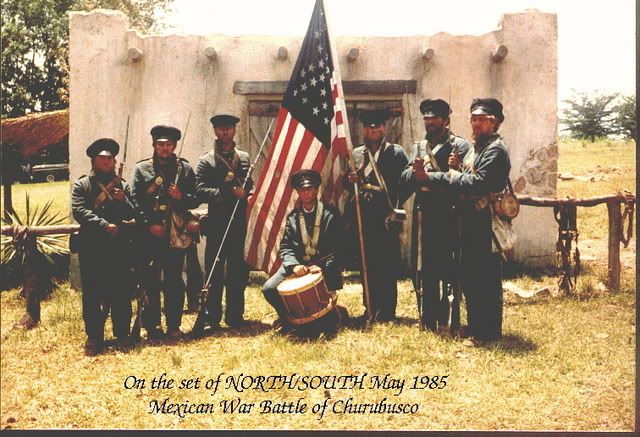
Over the winter, word came to us of the made for TV movie NORTH AND SOUTH which would be filmed near Natchez, Mississippi during the month of May 1985. Reenactors were being called to participate for a period of five days for the filming of the Mexican War Battle of Churabusco. I believe the infantry was offered $50/day with slightly more given to those who were bringing a cannon. (NORTH AND SOUTH was adapted from the John Jakes bestseller of two men, one from the North and one from the South, who became friends at West Point, went to Mexico and later on opposite sides during the Civil War. For the most part the book was a soap opera; it chronicled the pain, sorrow, and lust of family members who either jumped from one bed to the next or hatched devious plots of revenge or both.
I took one week's vacation from work with the plan that I would drive down with John Maki in my Mitsubishi. Gregg Higginbotham could not make the trip, so his gear was loaned to a Marine Corp buddy of Frank Kirtley's. At the last minute I learned that Charlie Pautler needed a ride so John and I had to make room for him. There was only room in the front cab of my Mitsubishi for two as the gearshift was right in the middle of the floor. A pallet of blankets was laid out in the bed of the truck with all the gear pushed to one side. We had a couple of John Maki wooden boxes with all our stuff including tents, plus we had a cooler that had snacks and suds. I still had an aluminum cover bolted on the back on my truck and it had two side windows, which could be opened for ventilation. We took turns between the three of us who would lay in the back.
Our route of travel was similar to one we took when we went to Champion's Hill some years back. I think we left on Saturday morning and arrived in Vicksburg about 12 hours later. This was our third visit to Vicksburg in 5 years and of course we had to take the driving tour. We ran into Skip Merriman and Jerry Vest while at Vicksburg so we conspired to travel the rest of the way to Natchez together. The five of us spent one night in a cheap motel, we had an authentic Cajun dinner somewhere along the way. I had a plate of fried frog's legs, and I think someone had a bowl of gumbo. We also stopped at a roadside fish market and Jerry Vest bought about 2 lbs. of boiled crawdads. I was offered, but I was hesitant to eat any of the monsters. I watched Jerry Vest and John Maki pop away a few with no side effects, so I said what the hell. The only part that is eatable is the ass end. These suckers had been boiled and then dipped in some kind of red pepper sauce or some shit. My lips and tongue felt as if I'd been French kissing a hot iron, but I developed a weird affection for the spicy crustacean's anyway.
To make a long story short, we finally arrived at the site where the movie was being made, some out of the way countryside near Natchez. We signed in, located our campsite, and began setting up the A tents. Frank Kirtley and his buddy Mike Neitze rolled in about the same time the rest of us did. Among the few faces we recognized among the reenactors was Joe Covais' Illinois volunteer's, Kyle McGonigle's Iowans, and Holmes Brigade pard Ken McElhaney who was throwing in with Dan Lawrence's artillery bunch from Texas. All the US Regular's were required to camp together, so we reluctantly threw our lot in with Kyle's Iowan's. Maki had piled all the boxes in the tent with him, so Charlie Pautler was forced to share an A tent with me. I think we spent about 5 days and 4 nights on this site and it was during this time that I got to know Charlie. We had been doing Mex War for about a year, but beyond rubbing elbows at these events, the only thing I knew about him was that he was the son of Missouri Confederate Brigade commander Don Pautler. After a long day getting blowed up on the hot, dirty movie set, we'd drag our tired ass bodies the quarter mile back to our tents, eat, then if not quite tired enough to fall asleep, we'd sit around, drink a little popskull and tell stories. Charlie and I concocted a ridiculous scheme to market a Civil War paper doll collection featuring Jefferson Davis-"anatomically correct." In our mind's eye we also wrote long Civil War narrative's featuring soldier's who were just "sittin' around packin' fudge, when all a-sudden, the yankee's showed up!"
Hollywood built an outdoor shower for us, but Charlie, Maki, and I decided to do without. Even as we got grimier as each day went by, and the bugs began to nest in our orifices, we went without even a whore's bath just to see who could go the longest. Finally on like the fourth day, Charlie went into town with some pards to go swimming at a hotel. One night, Hollywood handed out steaks and beer from a pickup truck that came through the camp. Like a herd of locusts, the reenactors descended on the treasure from the stars. Maki instructed us to fill our pockets with as much as beer and steaks as we could, even down our pants if need be. It looked like a bunch of overweight women elbowing each other just to get a pair of shoes during the bluelight special at the local retail store. Kyle McGonigle and his Iowans just sort of moseyed on over; they didn't want to get trampled on and they were in the belief that we'd leave something for them, beings we were all gentlemen. HA! When the smoke cleared there wasn't enough to feed a flea and so Kyle and his boys went back to camp with their heads hung low and nibbled on Slim Jims for supper. Meanwhile, us pukes from Missouri were laughing in the darkness and feasting on steaks and beer until the juice's ran down our chins.
One evening, some of the Illinois boys announced they were going into Natchez where there was a whorehouse. It seems Nellie's was a legalized, state run brothel and drew as many tourist to its door step as it did horny bastards. Beside's the usual merchandise, Nellie also sold T-shirt's. About a dozen of us crammed into a pickup with a large camper shell on top-the kind you can stand up in. We briefly got lost trying to find the right street, but then we were there-at an old ranch style house with many high-yellow colored gals running around in their flimsy's. Some of the sucker boys went to get his brass polished, but the rest of us were content to sit in the parlor with an old black granny who was the Madam. She took a shine to Maki and tried to romance him, but he told her we only came for the T-shirt's. To be honest the place didn't look all that clean for a tourist attraction and the T-shirts we washed before we put on.


Now then, it's finally time for me to get around to talking about what the movie set looked like and our experiences on it. Well, it was located about a quarter mile up a hill from our campsite. In the morning, we marched out as a battalion to breakfast. Hollywood fed us breakfast from a large circus tent. The spread would have made King Henry the VIII jealous. We had cold and hot cereals, fresh fruit, donuts, muffins and juice of all kinds. Eggs, bacon, ham, sausage, biscuits and gravy, etc. from a buffet. Just as the military has done throughout the centuries, Hollywood also travels on its stomach. The caterer's to the stars go "whole hog" when it comes to feeding people on a movie set. About mid-day, Hollywood would stop for lunch; the crew ate first because they had to hurry back to the set to get their props and equipment ready for the next shot. Everything and anything that could be killed, boiled, baked, and/or fried was consumed at lunchtime. Supper was the only meal not provided to the reenactor's while on the NORTH AND SOUTH movie set, so some guys would go into Natchez to eat or cook the rations brought from home.
"The first time the crew and cast ate lunch, the crew got there just before we did," remembers Ken McElhaney whom I am proud to include in these NORTH/SOUTH observations,"they were daintily using the right plastic utensils to put the right amount of food in the proper areas on their styrofoam trays when Maki and I hit the buffet line. John was covered in dirt and he grabbed whatever utensil was handy and dumped food on the tray, mixing potato salad with jello. When some of the jello was getting away from him, he just used his filthy hand and grabbed it, then slammed it back onto his tray. Next to me was some of the film crew with jaws agape and whispering under their breaths, "oh..my...GOD!". I didn't have time to apologize for John's behavior since I was slammin down food on my tray, too."
Once arriving on the set, we were in the midst of a small village of one floor adobe huts. However, Hollywood only built the front wall of the buildings-that which faced the camera. There were no back or sides what-so-ever with 2 x 4 lumber and sandbags holding it in place for support. The ground was very dry here with little or no vegetation, so Hollywood planted a number of small trees and weeds around the village and even spray painted the ground green to resemble grass. About fifty yards from the "village", a Stone Bridge had been built over a stream with even more "trees and weeds" planted along its bank. On the other side of the bridge and about another fifty yards was a trench line with about 6 artillery pieces lined up wheel to wheel. This was where the Mexican Army would be during the battle sequence. From a distance Hollywood hoped television viewers would get the illusion that this was a small Mexican village caught during a major battle. Broken artillery pieces, lost equipment, sandbags scattered about and a fallen tree were also added to the set to spice up the look of the battlefield. Over a dozen ground charges were set to go off at random intervals during filming, with several of those placed in the water. The ground charges consisted of placing large metal pans, which looked like Chinese woks, a couple inches below the ground and loading them with black powder, peat moss, potting soil, and pieces of corkboard. The charge's planted in the stream were obviously very different than those in the ground and had to be rigged to vomit water 50 feet straight up into the air.
What the reenactor's were called to do while on the set was basically "run around like chickens with their heads cut off" while explosions went off at our very feet. We would not to fire one shot during our entire time on the set. Our uniforms and faces were dusted with a variety of stains upon arrival on the set (we had to look campaign hardened). When the director called action, we either ran around in a panic or lay flat on the ground as "dead soldiers" while being peppered with potting soil and hot hunks of corkboard from the very close ground explosions. In the meantime, the principal actors were required to carry along a dialogue during this hellish confusion.


Patrick Swayze (pre-Dirty Dancing) and James Read were the two West Point chums-one from the South, the other from the North respectively. In their roles of Lieutenant's Main and Hazard, the script required them to shout brave encouragement's to their men, fire pistols, and sometimes perform acrobatic stunts by bouncing off logs or fencing with Mexican's. It was a combination of Errol Flynn meets Monty Python. At one point the two chums were confronted by an old nemesis from the past-an evil man whom the two had conspired against and gotten kicked out of West Point. Using political influence, this man had rejoined the US Army with the rank of Captain, and now he was ordering Lts. Main and Hazard to take some men on a suicide mission..."for a report of enemy strength at the bridge. Now move before I shoot you where you stand...for disobeying a direct order...from a SOUPerior officer!" I recall this exchange vividly, because the actor was delivering his lines from atop a 7-foot stepladder. The horse he rode in on was skittish and the actor could not control him too good. The reenactors were about ten yards from this scene and it had to be reshot several times before everyone got their lines perfect.
Old pard Ken McElhaney has another perspective of this scene and I gladly share that with the reader as well. "If I remember correctly, that second rate, Frank Sinatra wannabe actor who couldn't get the 'I heard you two were here...' speech right took, I believe, thirty six takes. You'll certainly want to confirm this with the others, but I do remember the script girl (or as I called her, the 'Crew Lush') barking out each take up to thirty six. Also, old baldie, or the leader of the 7th Illinois Cav, whose name escapes me at the moment ( Karl Luthin), told me that that particular horse our fave actor was sitting on was sixteen years old and had been in battles for the past ten years or so. Anyway, baldie blamed the actor for holding his pistolie next to the horse's head instead of over it. The horse would see the pistol and try to get out of the way, the actor would try to fight him back and the director yelled cut."
Between takes, the actors would catnap in folding chairs in the shade, go over their lines, rehearse a stunt, or play "hacky sack" with several members of the crew (that's when you kick a beanbag back and forth using only the side of your foot). Ken McElhaney recalls that "Pat Swayze wanted to take a piss break right before a take, the pink-panted director (or 'Popeye', as I called him because of his crappy sailor-ish hat) told Pat to hold it because he didn't want him going all the way back to his trailer. Pat, in the only cool move I ever saw him make, took three steps into the woods and let it go right in front of everyone."
It was during these breaks, that an actor would have a crew member spray a cool mist of water on his face (artificial perspiration we called it) or the crew member was sent to fetch a diet soft drink. The scene I observed was played out a few yards from me as one of these surfer-looking dud's with sunglasses whispered in his walkie-talkie for someone to bring up a cold DIET SPRITE for Mr. Swayze. We called these Hollywood assistant's "piss boys", after characters from the classic Mel Brooks movie HISTORY OF THE WORLD PART 1. Another "piss boy" brought back a couple cases of TWINKIES, compliments of actor James Read, which were handed out to the reenactors. Who the hell eats TWINKIES in 100 degree temperature? We did! It was like eating a SEALY mattress with sugar on it and we had to drink gallons of water afterwards just to reopen our throats.
The final scene involved the blowing of the bridge, with Patrick Swayze getting caught in the blast. We were told the crew was going to wrap up after this and prepare to go home. We were disappointed. We'd wanted them to film us actually fighting, not running like scared little girls. Finally word came down to stand by for a final scene. We were going to get our wish. As we waited, actress Leslie Anne Downe came slinking over like a cat. She seemed a little light-headed and sappy (might have been the heat), but she smelled real good. And was very easy on the eyes! It seemed in the TV Movie she would play the love interest of Patrick Swayze. After some harmless flirtation, she was led away by her handlers to her trailer where I'm sure a Hollywood "piss boy" was there waiting to attend to her 'needs'.
We'd been in formation for nearly an hour and it was near dusk. Finally we were called out. The Hollywood camera's were loaded with a low-light film and the director signaled our action to begin. With a joyous shout, we lined up in line of battle, with bayonets leveled at an imaginary foe, and marched forward. Then a halt and we fired a volley, then pressed on till out of camera frame.
So the movie was over. We loaded all our stuff that night, pulled out and spent the night in a nearby motel. One of the first things all seven of us did after checking in was to find a sit down restaurant and ordered several pitchers of ice water. The next morning it was back to reality as we headed home and the daily grind stone of 9 to 5 drudgery.
************************************The End?
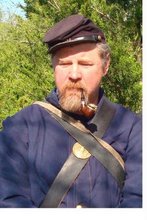
The Cornfield Fight-Wilson's Creek 1991

Here is another brief look at from CHIN MUSIC Volume Two: This snippet deals with the action in the cornfield fight. I was a company commander at this one. Our brigade was potraying the unit of US Regulars who fought in Ray's Cornfield.
---------------------------------------------------------------------------
Once the order was given to march, the blue line advanced down the slope one hundred yards until swallowed up by row after row of corn. The stalks grew so thick it was difficult to see the man next to you. Instead it was 'crash, crash, crash' as the corn stalks fell one by one as the human blue tidal wave pressed forward. As each stalk was pushed aside, corn dust was shaken loose until each man seemed covered in the stuff. It covered the uniforms, the weapons, and seeped into the nostrils, eyes, and throat.
After about five minutes tramping through this jungle vegetation, the blue line broke through to the clearing. In front of us was a split rail fence about waist high. Some men were already hunkered down behind it trading shots with the Rebel skirmishers. A few of their mountain howitzers opened up on us all well. Behind us our own artillery was talking back with its own dialogue of violence. To our extreme left, there was a line of spectators that I understand numbered 2,000. They were backed up along the road by sutler row and held back by yellow police tape.
I forgot to mention that I borrowed a sword from Gregg Higginbotham. It was a German saber that was about as tall and wide as John Maki. I exaggerate of course, but it was a good size hunk of steel that made me walk off balance whenever I wore it.
I had that saber drawn and was waving it at the enemy and saying some mighty hurtful words about their ancestry. We had not been given the order to fire yet and I was in front of the company waving that sword around like I was Conan the Barbarian. Maki and some of the guys in the battalion looked at me as if I had lost my mind. During my conniption fit, I almost decapitated Mike Gosser. I quickly apologized and gave him a smooch.
Finally, the battalions were given the order to fire and that gave me the excuse to hide behind the ranks. That's where all good officers go during the shooting match-to the rear to do a little 'coffee cooling' while the boys are getting shot at. Actually the officer stands behind the ranks and assists the file closers with discipline or helps a young private with his weapon, if it becomes fouled.
I don't know how many rounds the boys smoked, but the air was getting thick. We were surrounded by all that corn with no circulation coming through. We fired by battalion, by company, and we fired at will. As an officer, I was pretty much a non-factor. All I had to do was stand out of the way and try to keep my hair from getting mussed up while the boys did the devil's work of handing out punishment.
Finally there was a shout! The Rebel tyrants are pushing us, but we are in no hurry to give up ground. The blue lines slowly inch back through that forest tangle of corn. By this time, the stalks had been hacked or trampled to the ground till it looked like the aliens had left another crop circle in a farmer's field. We continued to ease our way to the rear even as the enemy hollers that dreaded Rebel Yell, a noise that sounds like someone is gargling with broken glass and razor blades.
So the losses began to mount in that terrible field of corn; the blue ranks are dissolving into a confused mob and dropping like horse flies. We fell back a full one hundred yards or more under the continual and relentless pressure of those unholy Missouri scarecrows. The survivors of the debacle formed some sort of line and marched off the field and into the sunset. That was the end of the Friday funfest!